Role
UI UX Designer
Timeline
2023
Tools
FigmaInVision
Skills
Wireframing & PrototypingUser Journey MappingLegacy System RedesignDashboard / Admin Panel DesignEnterprise DesignUX Research
Replacing ESS's Excel-based teacher management system with a centralized digital platform covering staffing, substitute tracking, payroll calculations, and billing across multiple US states.
The Challenge
The primary challenge was to modernize a legacy management system heavily reliant on Excel spreadsheets, macros, and manual reporting. These labor-intensive processes caused inefficiencies, data errors, and limited visibility into the client's vast network of teachers. The goal was to transform this manual operation into a centralized, intuitive digital platform capable of efficiently handling complex billing, time tracking, substitute management, and diverse user roles.
The Outcome
he result was an efficient, user-friendly platform that centralized teacher administration.
Key achievements included:
- Operational Efficiency: Eliminated dependency on Excel, streamlining daily operations.
- Accuracy: Significantly improved efficiency in tracking payroll and tax data.
- Visibility: Provided greater control and transparency over the teacher network.
- Data-Driven Decisions: Enabled better decision-making through real-time reporting and in-app analytics.
- Impact: The delivered solution represented a qualitative leap in the client's operational management.

Challenge Understanding
ESS is a company that manages hundreds of teachers across multiple US states, placing them in schools, tracking substitutes, and handling all the billing that comes with it. When I joined the project, every piece of that operation lived in Excel. Complex macros, manual reports, everything done by hand.
The financial logic was the hardest part to untangle. Substitute teachers earn more than regular teachers, so every absence and replacement had a direct payroll impact. Different teachers had different rates depending on assignment, school district billing required detailed documentation, and the whole thing had to work across states with different regulations. A single Excel mistake meant incorrect paychecks.
The challenge wasn't just digitizing a spreadsheet. It was understanding the business logic buried in those macros well enough to redesign it as a real system.
Navigation Flow

Design Approach
I started with a deep analysis of the existing Excel macros, not to replicate them but to understand the business rules they encoded. That analysis informed the flow diagrams and wireframes before any interface work began.
Two distinct user roles shaped the entire structure: Billers, who needed to see teacher assignments, school details, subjects, and generate billing reports; and Administrators, who managed templates, user roles, and system configuration. Same platform, very different needs. Each role had access only to what their job required.
I worked directly with ESS's organizational leads alongside the PM, following ESS's existing style guide for all color and visual decisions. The design had to feel familiar enough that the transition away from Excel wasn't jarring, while being structured enough to support the database logic underneath.
Low - Mid Fidelity Wireframes
Interaction Flow Diagram

Implementation & Integration
The core of the implementation was the payroll logic: the system had to automatically calculate pay differentials between regular and substitute teachers, track absences with financial precision, and generate billing documentation for multiple school districts simultaneously.
Each teacher profile handled real complexity: one teacher could work at multiple schools, teach different subjects at each, have substitute availability, and carry different scheduling rules. The system tracked all of it and surfaced it in clean, role-appropriate views.
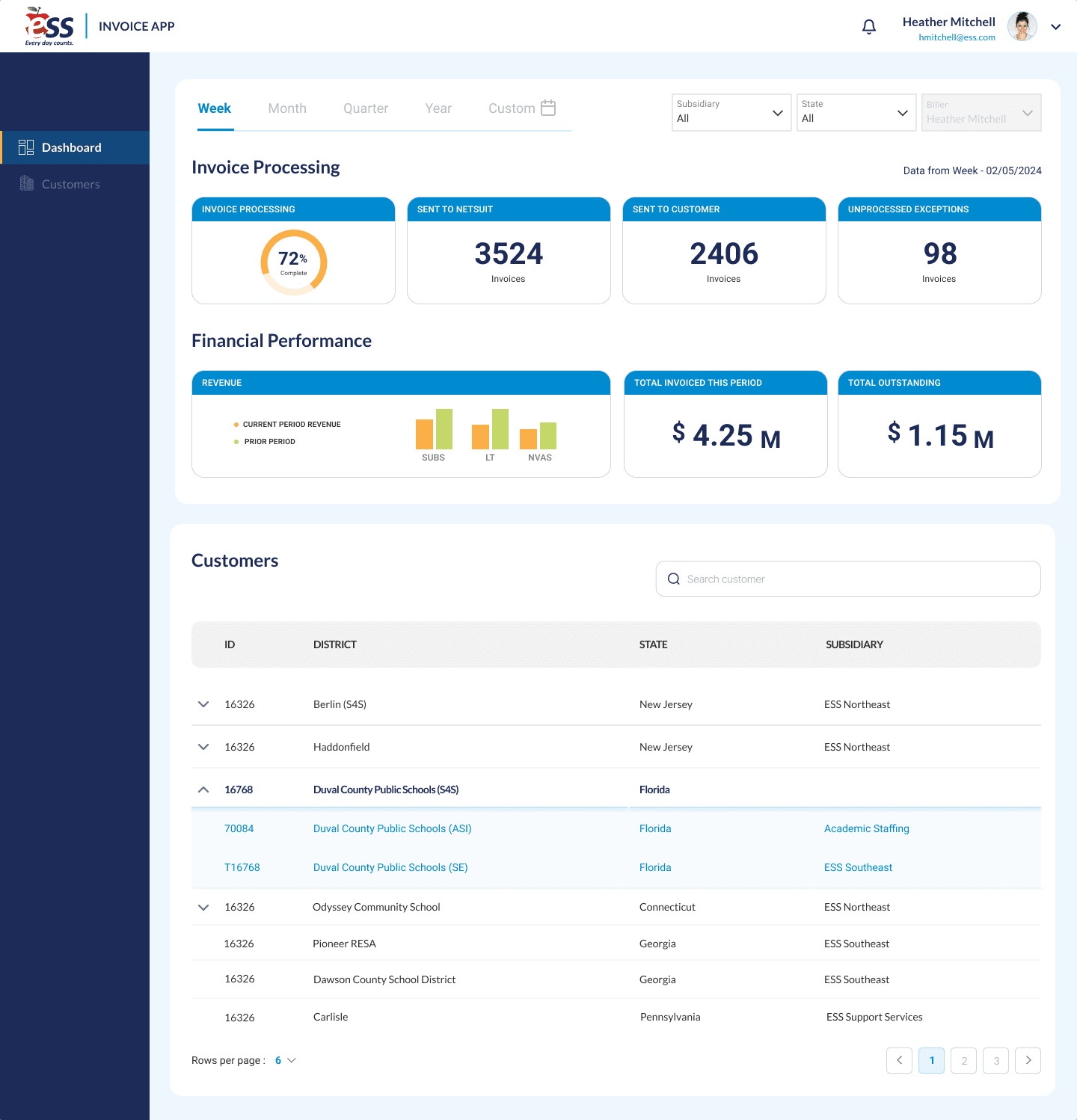
Billers got streamlined access to teacher lists, school assignments, attendance records, and report generation. Administrators got full control: template management, user role configuration, and system-wide settings. The separation kept each interface focused and reduced training friction for a team coming from a single shared spreadsheet.
Results & Learnings
The ESS platform replaced their Excel operation with a database-driven system covering teacher management, substitute tracking, attendance, payroll calculation, and billing, across multiple US states.
Deliverables included interaction flow diagrams, low and mid-fidelity wireframes, and complete role-based interface designs for both Billers and Administrators, built on ESS's existing style guide.
This was the most complex project I worked on at Anexinet, not because of the visual design but because of the discovery phase. Understanding the macro logic buried in those spreadsheets, and translating it into flows that made sense to users who had never worked in a structured system before, was where most of the real design work happened.
Tags
#management#ux/ui#uxresearch#dashboard#b2b
Next Case Study