Role
UI UX Designer
Timeline
2021
Tools
SketchFigma
Skills
User Journey MappingWireframing & PrototypingEnterprise DesignDashboard / Admin Panel Design
Centralizing GORE's communication preferences across medical and industrial divisions with robust administration tools.
The Challenge
Create a flexible system that manages communication preferences for GORE's multiple industrial divisions (medical professionals, industrial engineers, and textile specialists), each with completely different needs, while providing internal teams with tools to manage this complex multi-industry ecosystem.
The Outcome
Successfully implemented BMPD and PSD platforms with comprehensive admin tools, enabling GORE to personalize communications across industries while maintaining operational efficiency and regulatory compliance.
Challenge Understanding
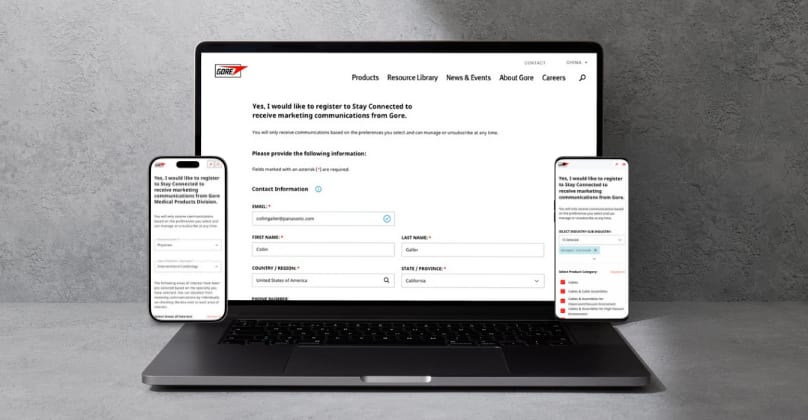
GORE operates across industries so different they might as well be separate companies (medical devices, industrial cables, performance textiles), yet they needed a unified communication strategy. The project spanned four sub-brands: BMPD (medical), PSD (industrial), GORE-TEX, and Vortex. Each served completely different audiences with different regulatory constraints, product catalogs, and communication needs.
I took over from another designer, Andrés, who had created the initial sketches and concepts. From that point on, I owned the project end to end. The team included a PM, a Business Analyst, a stakeholder on GORE's side, and approximately five developers. The project ran in two phases: Phase 1 focused on the end-user preference system, and Phase 2 on building the internal admin portal.
The core challenge was designing a system flexible enough to serve a doctor selecting medical specialties, an engineer navigating thousands of industrial cables, and a sports enthusiast choosing textile products, all through one coherent design logic, embedded within GORE's existing websites so users never felt they had left the main site.
Design Approach
My first task was understanding what Andrés had built and where the gaps were. I studied his initial sketches, then expanded the design to cover the full complexity of GORE's operations. The work started in Sketch and later migrated to Figma as the project evolved.
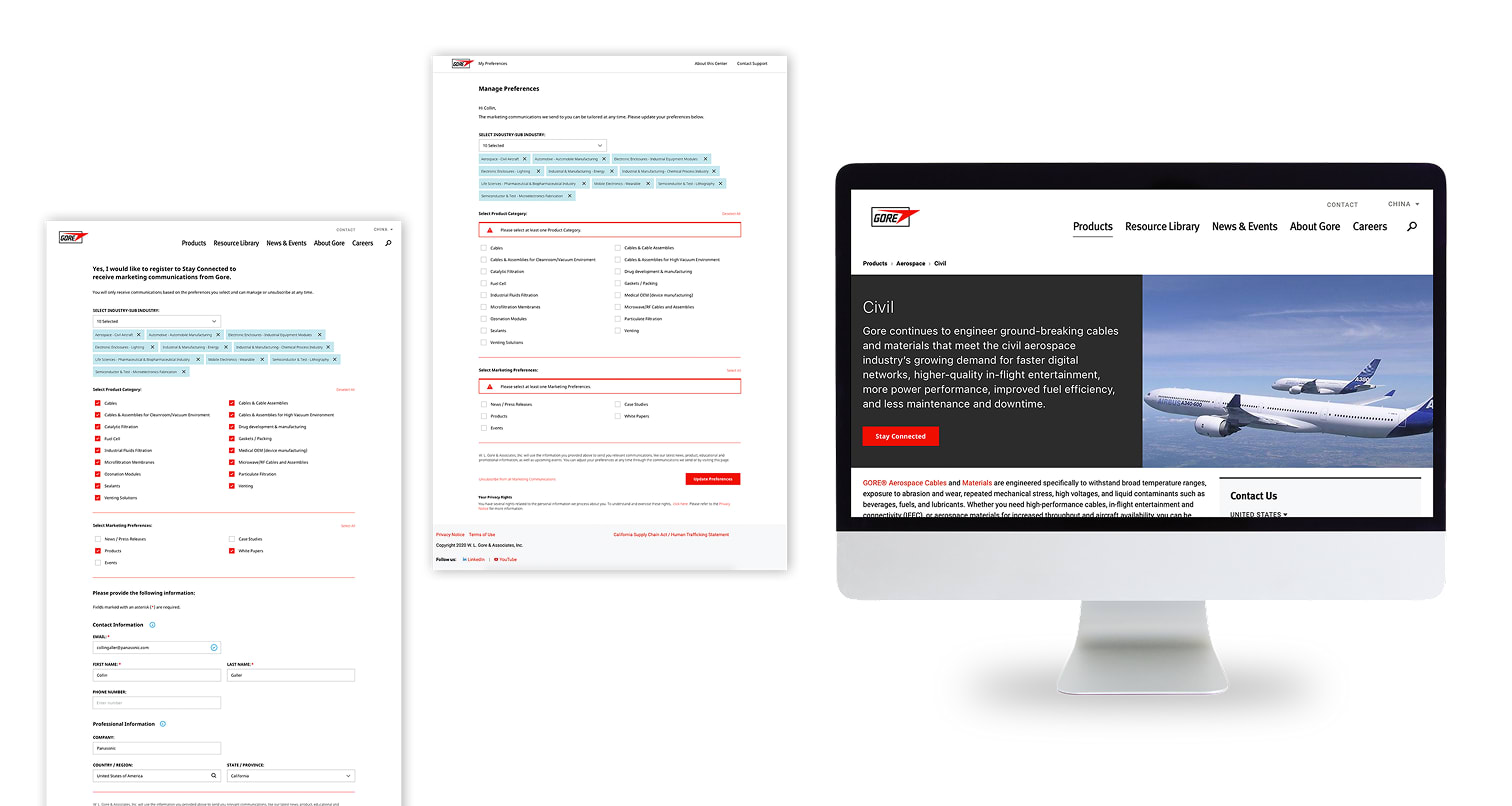
For Phase 1, I designed registration flows that felt native to each division's existing website: the sections were embedded, not standalone apps, so the visual language had to match GORE's established brand. We didn't have an existing style guide for these new sections, so I created components based on GORE's main site colors and typography, extending their design system with forms, checkboxes, dropdowns, and preference selectors.
One solution I'm particularly proud of was the "login-less" preference management. Users could modify their communication preferences directly from an email link without creating a traditional account. For busy doctors and engineers, this removed a real friction point. On GORE's side, it still captured all the user data they needed for segmentation and analytics.
The PSD industrial division was the most technically complex. Products had deep parent-child hierarchies: Aerospace branches into cable types, which branch into specific products. I had to design selection interfaces that made these nested relationships intuitive for end users choosing their areas of interest.
Implementation & Integration
Phase 2 was the admin portal: the control center for GORE's internal teams. This is where the real operational complexity lived.
Administrators needed to activate or deactivate entire industries in real time. If PSD decided to discontinue an Aerospace product line, deactivating the parent category had to cascade correctly through all child products, with no orphaned items and no broken references. I designed the interface so these hierarchical relationships were visible and manageable, with clear warnings about what would be affected by each change.
The portal also handled multi-language management. GORE operates globally, so administrators could control which languages were available by region: turning off Italian for a specific market, for example, would remove it from the preference selection interface for that region. Regional settings, compliance documents, and consent management all lived in this same admin layer.
User Records was another critical section. Not everyone could access GORE's specialized information: there was an approval system where administrators reviewed registrations and decided who qualified. The dashboard showed complete user profiles, subscription status, division membership, and consent history.
I designed all four sub-brands (BMPD, PSD, GORE-TEX, and Vortex) following the same modular logic with industry-specific adaptations. BMPD and PSD went into full development. The GORE-TEX and Vortex proposals were designed and delivered but ultimately were not built.
Results & Learnings
BMPD and PSD launched successfully, giving GORE a unified system to manage communication preferences across their medical and industrial divisions. The additional proposals for GORE-TEX and Vortex demonstrated that the modular architecture could scale to new divisions without rebuilding core logic.
This was one of my most complex projects at Anexinet. Designing for four different industries simultaneously, each with its own audience, product catalog, and regulatory requirements, taught me how to build systems that are consistent in logic but flexible in presentation. The admin portal work specifically sharpened my ability to translate complex data relationships into manageable interfaces.
Taking over from another designer and completing the project solo also reinforced an important skill: reading existing design decisions, understanding the reasoning behind them, and extending them rather than starting over. In enterprise work, that ability to inherit and evolve is just as valuable as creating from scratch.
Tags
#B2B#UX/UI#responsivedesign#enterprise#multi-language
Next Case Study